Description
Clematis armandii Staked | Armand clematis
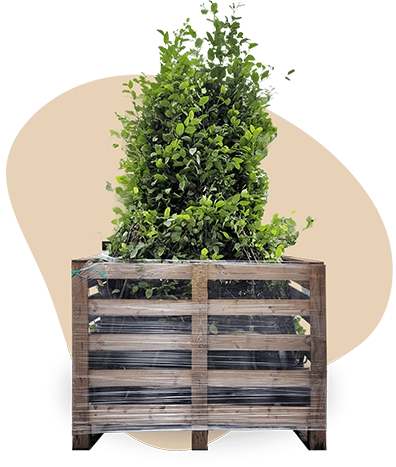
A standard Armand clematis is a distinctive standard-trained form of Armand clematis, supplied as Clematis armandii gestokt. Its upright presentation creates a clear vertical accent, while the growth that develops from the support keeps the natural habit of a climbing and scrambling plant. This gives the plant a defined garden presence without presenting it as a shrub or standard tree. The dark green leaves remain on the plant throughout the year, making it an evergreen clematis with interest beyond the flowering season. In early spring, fragrant white flowers appear, adding both colour and scent to a sheltered part of the garden. With suitable support, the climber can reach up to approximately 6 m in height. A mature width is not supplied, so the visual effect is best understood as a vertical feature rather than a broad plant. The plant also bears fruit, but no further description is supplied. The standard-trained form suits gardeners who want the character of a fragrant evergreen climber in a more defined and structured presentation. As part of the clematis genus, it brings climbing growth, evergreen foliage and early flowering together in one carefully presented garden plant. In the UK, choose a sheltered position, as severe frost can damage the plant.
Key features of Armand clematis in standard form (Clematis armandii gestokt)
- Early, fragrant flowering is one of its notable features. White flowers appear in March and April, bringing scent and brightness to the garden at the start of the season. This makes the standard-trained presentation especially useful where the flowers can be enjoyed at eye level.
- The dark green leaves are evergreen, so the plant keeps its foliage through the year. The foliage gives the upright form a steady visual presence outside the flowering period and supports its use as an evergreen climbing plant.
- Place it in full sun or partial shade. A sheltered position is important in a UK garden, particularly where exposed conditions or severe frost may occur. The plant is not described as wind-resistant, so protection from exposed sites is advisable.
- Use humus-rich, well-drained and lightly moist soil. Reliable drainage is important, while the soil should retain light moisture rather than becoming dry. These conditions help suit the climbing plant to a carefully prepared garden position or container setting.
- The growth is climbing and scrambling, with a supplied mature height of approximately 6 m. The standard-trained form gives this habit a defined upright starting point, while new shoots remain climbing and scrambling rather than becoming shrub-like.
Uses of standard Armand clematis in the garden
- Use this standard-trained Armand clematis as a vertical accent on a trellis, wall, pergola or fence. Its upright presentation gives structure to the planting, while the shoots can develop through the available support. It can also be grown in a pot where a defined climber is wanted.
- Its supplied hardiness range is approximately -12.2°C to -6.7°C, USDA zone 7. In the UK, this means a sheltered position is important, especially during severe frost. Do not treat it as a plant for exposed sites where cold conditions may be more damaging.
- The plant works well with general low-growing or contrasting planting around its vertical accent. It can also be considered alongside other climbers, evergreen structure plants or container planting, provided the setting offers suitable shelter, drainage and light moisture.
- The main ornamental value comes from the combination of dark green evergreen foliage, fragrant white flowers in March and April, and the clear upright presentation created by the standard-trained form. This gives interest through the year without losing the natural character of a climber.
- Choose it when a pot, wall or garden support needs vertical interest with evergreen foliage and early fragrance. The form helps define the space, while the climbing and scrambling growth adds movement around the support.
This standard Armand clematis is suited to a sheltered UK garden position where evergreen foliage, early fragrance and vertical structure are valued. Its form offers a clear way to enjoy a climbing plant in a pot or against a garden support, provided the site has suitable drainage and protection from severe frost.