Description
Ilex crenata 'Blondie' Parasol | Japanese holly
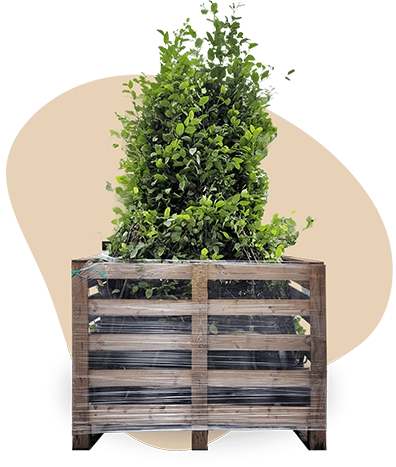
Japanese holly parasol is the distinctive parasol form of Ilex crenata 'Blondie', a compact evergreen shrub also known as Japanese holly or Japanese box-leaved holly. Supplied in a raised, spreading shape, this plant has a clear parasol-like silhouette that gives it a strong presence without the scale of a large tree. Its compact, bushy framework is shaped into a broad outline, making the form easy to recognise in a garden or container. The foliage is green to yellow-green and remains evergreen throughout the year, so the plant provides lasting structure in changing seasons. Small white flowers may appear, but they are not the main ornamental feature. As a fruit-bearing shrub, it can also form fruit, although the foliage and shaped outline are the key reasons to grow it. This Japanese holly is relatively low-maintenance and suitable for shaping, which makes it useful for topiary and formal planting. It also works well in containers, including as a patio feature where its raised crown can be viewed clearly. Good drainage is important, especially in the wet conditions that are common in the UK. As a member of the Ilex genus, it combines evergreen character with a compact habit and a carefully defined parasol form.
Key features of Japanese holly (Ilex crenata 'Blondie') in parasol form
- Compact parasol structure: This evergreen Japanese holly has a compact, bushy framework shaped into a spreading parasol-like silhouette. The supplied form creates a clear focal structure and differs from a free-growing shrub.
- Evergreen foliage and modest flowering: The leaves are green to yellow-green and remain evergreen. White flowers appear in May and June, but flowering is modest and is not the main ornamental feature of this plant.
- Light and soil: Choose full sun or partial shade. It grows best in humus-rich, well-drained soil that remains lightly moist, with an acidic to neutral pH. An open soil structure helps prevent prolonged waterlogging, which is especially important during wet UK winters.
- Practical garden value: Its compact growth and shaped outline make it suitable for relatively low-maintenance topiary, formal planting and containers. It is also a useful choice for container plants where an evergreen, structured form is wanted. No specific wildlife, toxicity or wind-resistance claim is made for this product.
Uses of the Japanese holly parasol in the garden
- Solitary accent: The Japanese holly parasol works well as a solitary accent in a border or formal garden setting. Its raised crown and spreading outline draw the eye and provide a defined shape among lower planting.
- Containers and patios: In a container, this parasol-shaped evergreen shrub can become a clear patio feature. The raised form offers vertical emphasis and a broad outline without the space or visual effect of a large tree.
- Topiary and formal planting: The compact, bushy structure is suited to topiary and formal planting. Its evergreen foliage keeps the design visually present through the year, while the parasol shape adds order and architectural character.
- Hardiness: This plant is hardy to approximately -23.3°C to -17.8°C and is listed as USDA zone 6. In the UK, a sheltered position and well-drained soil remain important, particularly where winter moisture can collect.
- Plant combinations: Combine it with evergreen or deciduous shrubs, perennials or grasses that prefer full sun or partial shade. Choose plants with similar requirements for acidic to neutral, well-drained soil that stays lightly moist.
The evergreen foliage, compact structure and distinctive spreading silhouette give this parasol-form Japanese holly year-round shape and a strong architectural focal point. It suits a container, patio or formal garden setting where a carefully structured evergreen accent is required.