Description
Hedera colchica 'Dentata Variegata' Staked | Persian ivy
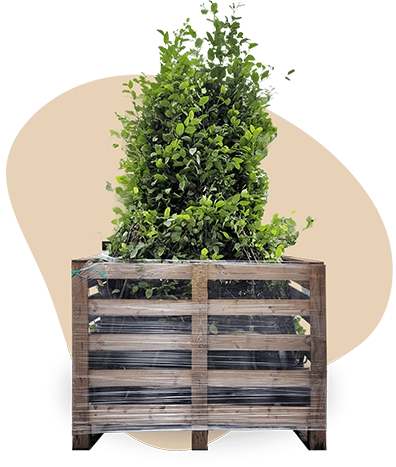
Persian ivy standard is a raised, decorative form of Hedera colchica 'Dentata Variegata', also known as Persian ivy or Colchis ivy. The name ‘Dentata Variegata’ refers to the variegated cultivar, while this plant is supplied in standard form. Instead of presenting the plant mainly as a spreading climber, the foliage is lifted above the container to create a clear, ornamental silhouette. Its evergreen leaves combine green, white and cream, bringing colour and structure to a shaded or partially shaded position throughout the year. As an evergreen climber, it has spreading growth, but the standard training gives that growth a raised and more ordered presentation. This makes it suitable for a pot on a UK terrace or balcony, or as a specimen plant in a prominent garden position. It can also add height where a normal climbing ivy would have a different visual and spatial effect. The foliage is broadleaf and decorative, without a precise leaf shape being the main feature. Green to yellow-green flowers may appear in September and October, although flowering is not the primary ornamental attraction. Fruit-bearing is recorded, but the main value of this plant lies in its evergreen, variegated foliage. It is a low-maintenance choice within the hedera range.
Key features of Persian ivy (Hedera colchica 'Dentata Variegata')
- The foliage stays evergreen and shows a balanced mix of green, white and cream variegation. The decorative ivy leaves provide year-round interest, while the raised standard form keeps the foliage clearly visible above the pot.
- Flowering is not the main ornamental feature. Green to yellow-green flowers may appear in September and October, adding a late-season detail to the plant without taking attention away from the variegated leaves.
- Choose partial shade to shade for this variegated Persian ivy. Avoid strong afternoon sun, especially where it may affect the appearance of the lighter foliage. A sheltered position can also help the plant sit comfortably in a UK garden, terrace or balcony setting.
- Use humus-rich, well-drained soil that remains lightly moist. Good drainage is important, particularly in containers, while an open soil structure helps prevent the roots from standing in excess water. These conditions also suit a evergreen plant used for long-lasting structure.
- This climber can become large, so allow sufficient room for the foliage to develop. In standard form, its growth is trained and presented above the container, creating a raised focal point rather than a low, spreading ground-level display.
Uses of the Persian ivy standard in the garden
- Use the Persian ivy standard in a pot as a specimen plant, or place it on a terrace or balcony. The raised foliage gives the container more height and presence, making it suitable for a prominent position in a shaded or partially shaded area.
- The supplied hardiness range is approximately -23.3°C to -17.8°C, corresponding to USDA zone 6. This gives useful guidance for its hardiness, although conditions can vary between UK gardens and local microclimates.
- Its strongest ornamental value comes from the combination of an elevated standard silhouette and evergreen green, white and cream foliage. The raised form separates the leaves from the container and creates a clear visual structure throughout the year.
- Combine this standard with shade-tolerant, moisture-loving container or garden plants. Shade plants, evergreen foliage plants and complementary container planting can help create a balanced display without hiding the raised shape of the ivy.
- The standard form adds height, structure and year-round colour without relying on flowers as its main feature. It is therefore useful where a pot, terrace, balcony or shaded garden position needs a distinct vertical element.
This evergreen Persian ivy standard is a practical choice for adding variegated colour and raised structure to a shaded pot, terrace, balcony or garden setting.