Description
Corylus avellana 'Anny's Red Dwarf' On a standard | Red hazel on a standard
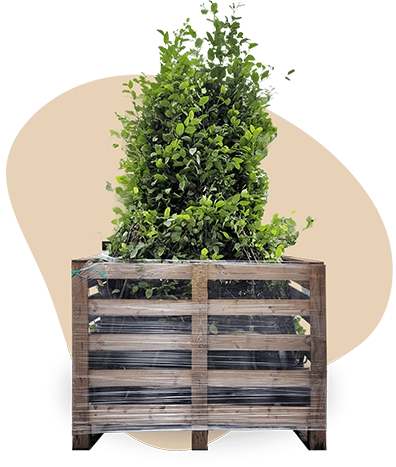
Red hazel on a standard is Corylus avellana 'Anny's Red Dwarf' supplied in a standard-trained form. Also known as purple-leaved hazel, it has a raised crown carried above a clear stem, rather than the lower shape of a shrub-grown hazel. This gives the plant a defined, compact silhouette and a stronger ornamental presence in the garden. The crown is compact, bushy and upright, with an average mature height of approximately 200 cm. Its decorative broadleaf foliage ranges from red to dark red, although green tones can also appear. The plant is deciduous, so the foliage is not present throughout the year. Yellow and brown flowers appear early in the season, adding interest in February and March. It can bear fruit, although fruiting is not guaranteed. The standard form is useful where a raised crown can add height and structure without needing the footprint of a large tree. It suits pots, terraces, borders and small gardens, where its foliage colour can be seen clearly. As part of the corylus group, this particular cultivar combines a compact habit with the spatial effect of a standard-trained plant.
Key features of red hazel on a standard (Corylus avellana 'Anny's Red Dwarf')
- Early seasonal interest: Yellow and brown flowers appear in February and March. This early flowering adds a clear seasonal feature before many later garden plants are in bloom.
- Decorative deciduous foliage: The broadleaf foliage is red to dark red, with some green tones also possible. The colour gives the compact crown a strong visual presence during the growing season.
- Compact standard form: The growth is compact, bushy and upright. Its crown is carried above a stem, creating a raised focal point and a clear structure that is distinct from a shrub-grown hazel.
- Aspect and soil: Choose full sun or partial shade. In the often wet conditions of UK gardens, use fertile, humus-rich, well-drained soil that remains slightly moist. Avoid soil drying out, while also avoiding compacted or waterlogged ground.
- Hardy growth: This plant is hardy to approximately -28.9°C to -17.8°C, corresponding to USDA zones 5 to 7. Performance can still vary between UK gardens, depending on local conditions and shelter.
- Garden placement: Its compact shape makes it suitable for container plants, as well as borders and small garden settings. The raised crown helps create definition where a low shrub would have less visual impact.
Uses of red hazel on a standard in the garden
- Specimen planting: Use this red hazel on a standard as a specimen or accent plant in a pot, on a terrace or in a border. The elevated crown can be viewed clearly and gives a defined focal point without the scale of a large tree.
- Small gardens: The standard-trained form adds height and structure while retaining a relatively compact footprint. It is useful where a shrub would look too low, but a larger tree would not suit the available space.
- Colour contrast: The red to dark red foliage is the main ornamental feature. Combine it with plants that offer contrasting green foliage or complementary seasonal interest, so the crown remains visually clear.
- Plant combinations: Compact ornamental shrubs, perennials and seasonal planting can be used around it, provided they do not overwhelm the raised crown. This keeps the stem and elevated shape an active part of the design.
- Hardiness in UK gardens: It is hardy to approximately -28.9°C to -17.8°C, or USDA zones 5 to 7. This gives useful guidance for UK gardeners, although identical performance should not be expected in every local microclimate.
This standard-trained red hazel suits gardeners seeking foliage colour, clear structure and a compact ornamental feature for a pot, terrace, border or small garden.