Description
Acer palmatum 'Beni Maiko' standard tree 120 cm C35 | Japanese maple
Japanese maple on a standard Acer palmatum 'Beni Maiko' brings the character of a Japanese maple into a raised, tree-form display. Supplied on a standard, this deciduous broad-leaved tree has a compact, upright growth habit and a rounded crown that is clearly presented above the ground. The elevated stem creates a decorative feature-tree effect without requiring a large footprint, making it useful for UK gardens, patios and terraces. The young foliage is a striking red, then develops through green tones before showing orange and red shades in autumn. This seasonal change gives the plant interest well beyond its modest red flowers, which are not the main ornamental feature. As a compact Japanese maple, it works well as a specimen in a suitable container or as a focal point in a sheltered garden position. It is not fully low-maintenance: the root zone needs consistent moisture, while the plant also benefits from shelter and good drainage. Choose a position protected from strong, drying winds, particularly in a mild but wet UK climate. This Japanese acer belongs to the acer genus and is supplied specifically as Acer palmatum 'Beni Maiko' on a standard.
Key features of Japanese maple (Acer palmatum 'Beni Maiko') on a standard
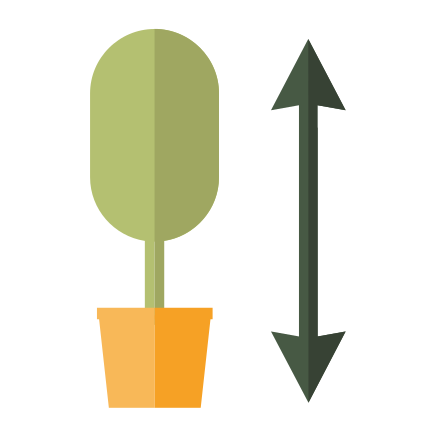
- Raised ornamental form: The stem lifts the compact, rounded crown above the ground. This gives the tree a clear silhouette and a neat feature-tree effect, rather than a ground-level shrub habit. Its compact growth suits spaces where a strong focal point is wanted without a large footprint.
- Foliage and flowers: Red young leaves develop into green foliage and later show orange and red tones. The autumn colour is a key part of its ornamental value. Modest red flowers appear in May and June, but flowering is not the main feature.
- Aspect and wind protection: Grow in partial shade or sun in a sheltered UK position. Protection from harsh afternoon sun can be helpful where relevant. Strong winds can damage the plant, so avoid exposed sites and drying winds.
- Soil and containers: Use humus-rich, well-drained, lightly moist soil that is acidic to neutral. The root zone should not be allowed to dry out. A free-draining, open and well-aerated growing medium is important, especially when this plant is used on a patio, terrace or balcony in a suitable container. It is also a useful choice within the standing trees category.
Uses of a Japanese maple on a standard in the garden
- Specimen and feature plant: This Japanese maple tree on a standard works well as a specimen in a sheltered UK garden. The raised, rounded crown adds height and structure while keeping the planting footprint compact. It can form a clear focal point near a seating area or within a carefully planned garden view.
- Patios, terraces and balconies: In a suitable container, it can bring the look of a red Japanese maple on a standard to a patio, terrace or balcony. The elevated crown gives a stronger vertical presence than a low planting form. Container exposure should be considered carefully, particularly in windy positions, and adequate moisture must be maintained.
- Japanese-style planting: The rounded crown and changing foliage suit a Japanese-style garden or a restrained woodland-style setting. Combine it with ferns, grasses or other low-growing shade-tolerant planting where their requirements match. Keep companion planting simple so it does not compete with the foliage or ornamental silhouette.
- Hardiness and local conditions: The supplied hardiness range is USDA zones 5–8, with temperatures of approximately -28.9°C to -12.2°C. In the UK, consider the local microclimate and the extra exposure of a container. A sheltered position, good drainage and protection from strong winds remain important.
The red young foliage, vivid orange and red autumn colour, and elevated rounded crown give this Japanese maple on a standard interest through the seasons. It is a strong choice for adding seasonal colour and structure to a sheltered UK garden, patio or container display.