Description
Hibiscus syriacus 'Red Heart' half-standard tree 90 cm trunk height C10 | Rose of Sharon
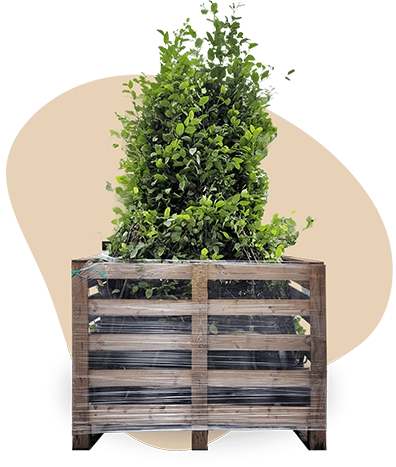
The half-standard Rose of Sharon is Hibiscus (Hibiscus syriacus 'Red Heart') shrub, supplied in a raised half-standard form. Also known as Shrub Althea or Syrian hibiscus, it is an upright and bushy deciduous flowering shrub with a clear stem and an elevated crown. This structure gives the plant a more open silhouette and a stronger vertical effect than a shrub that branches from ground level. The green leaves appear relatively late in spring, which is a useful characteristic to remember in a UK garden. From July to September, the crown produces abundant, striking two-coloured flowers in white and red. The contrast gives this Rose of Sharon strong ornamental value during late summer, when the raised crown can be seen clearly above lower planting. It can reach approximately 300 cm in mature height. No reliable mature width is provided, so the plant is best considered for its height and crown structure rather than a fixed spread. As a deciduous broadleaf shrub, it loses its leaves for winter. The cultivar name is 'Red Heart'. Listed as fruit-bearing, it is valued here for its flowers, foliage and form. As a member of the hibiscus genus, this half-standard Rose of Sharon is especially suited to gardens where a specimen plant with a defined shape is wanted.
Key features of Rose of Sharon (Hibiscus syriacus 'Red Heart')
- Flowers: The flowers are abundant and visually striking, with a clear contrast between white and red. Flowering takes place from July to September, bringing colour to the garden in late summer.
- Foliage and growth: The plant has green leaves and an upright, bushy growth habit. It is deciduous and may leaf out relatively late in spring. The half-standard form has a raised stem supporting the flowering crown above ground level.
- Position: Choose full sun or partial shade. In UK conditions, a bright, sheltered position can help the elevated crown remain a clear feature in the garden. The form works well where a vertical accent is useful.
- Soil: Plant in well-drained, humus-rich and lightly moist soil. Good drainage is important, so the ground should not remain persistently waterlogged. Neutral to alkaline soil is suitable, including calcareous soil.
- Garden character: The raised stem and bushy crown create a more elevated and open silhouette than a shrub branching from the base. This makes it a natural choice among flowering shrubs when the shape of the plant should remain visible.
Uses of half-standard Rose of Sharon in the garden
- Specimen planting: The half-standard Rose of Sharon is well suited to a visible position as a specimen plant. Its elevated crown, upright outline and two-coloured flowers create a clear focal point without the low, base-branching profile of a conventional shrub.
- Borders and group planting: In a border, the raised crown adds height and structure while leaving the lower level available for complementary planting. It can also be used in a group where several elevated crowns help define the planting area.
- Combining plants: Pair the plant with lower perennials, ornamental grasses or compact shrubs. Ground-level planting keeps attention on the crown and allows the white and red flowers to stand out during late summer.
- Hardiness: The supplied hardiness range is approximately -28.9°C to -12.2°C, equivalent to USDA zones 5 to 8. This indicates a hardy Rose of Sharon for many UK gardens, although results can still vary between local conditions and exposed or sheltered microclimates.
This half-standard form adds height, structure and a strong vertical accent without taking the same visual shape as a shrub that starts at ground level. It is particularly useful where a late-summer flowering feature with an elevated crown and clear garden structure is wanted.