Description
Cotoneaster dammeri 'Streibs Findling' standard tree 80 cm C5 | Dammer's cotoneaster
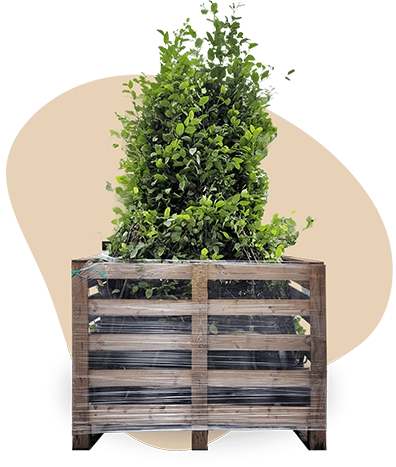
Dammer's cotoneaster standard is a raised form of Cotoneaster dammeri 'Streibs Findling', also known as Dammer's cotoneaster or Bearberry cotoneaster. Unlike the low, ground-covering habit often linked with this type of plant, the standard form carries its compact growth above a clear stem. This creates a spreading and gently overhanging crown with a distinct raised silhouette. The green foliage is evergreen, so it provides structure throughout the year. Small white flowers appear in late spring, followed by red berries that add seasonal colour. The combination of evergreen leaves, flowers and berries gives this plant interest across several seasons. It is a hardy and low-maintenance choice for a UK garden, provided the soil drains well. Dammer's cotoneaster standard is particularly useful where a raised ornamental feature is needed without introducing a large tree or a broad shrub. It works well in a pot, on a patio or terrace, in a rock garden, or as a solitary accent in a carefully positioned display. As part of the cotoneaster group, it brings the familiar evergreen character of this plant type together with the clear form of a standard.
Key features of Dammer's cotoneaster in standard form (Cotoneaster dammeri 'Streibs Findling')
- The flowering period is relatively short but attractive. Small white flowers appear in May and June, bringing a light seasonal accent to the raised crown.
- The foliage is green and evergreen. It stays present through the seasons and helps the plant retain its compact, spreading and gently overhanging appearance.
- This standard form grows with its foliage above the stem. The crown remains compact, spreading and overhanging, creating a raised ornamental silhouette rather than a low ground-covering shape.
- Choose full sun or partial shade. A reasonably sheltered position is suitable for UK gardens, especially where the plant is displayed in a pot or on a terrace.
- The soil should be humus-rich, lightly moist and well drained, with an open structure. Good drainage is important because the plant can be sensitive to persistently wet or waterlogged conditions, particularly during wet UK winters.
- Red berries follow the white flowers and add further ornamental value. They provide seasonal colour, while the evergreen foliage keeps the display visually present outside the flowering period. This makes it a useful choice among evergreen ground covers, although the standard form is presented above the ground rather than as a low carpet.
Uses of Dammer's cotoneaster standard in the garden
- Use Dammer's cotoneaster standard as a solitary accent in a prominent position. It is also suitable for a pot, patio or terrace, where the raised crown can be seen clearly from nearby.
- The standard form is a suitable subject for a rock garden. Its compact outline works well in a smaller display area, while the evergreen leaves, white flowers and red berries add changing seasonal detail.
- This plant has a supplied hardiness range of approximately -28.9°C to -17.8°C, corresponding to USDA zones 5–7. Local UK conditions and garden microclimates can still vary, so a well-drained and reasonably sheltered position remains important.
- Combine it with low-growing plants that suit well-drained sites and do not hide the stem or overhanging crown. Evergreen ground-cover plants, compact perennials and rock-garden plants can provide useful design partners when kept low around the raised silhouette.
- Its main ornamental value comes from the evergreen green foliage carried in a raised, compact, spreading and overhanging crown. White flowers in May and June and red berries add further colour without changing the clear structure of the plant.
- The raised presentation gives a compact planting area a clear focal point. It adds vertical interest to a container display while remaining smaller in visual scale than a large standard tree.
This evergreen Dammer's cotoneaster standard combines year-round foliage with a raised ornamental silhouette for a pot, patio, terrace or carefully positioned garden accent.